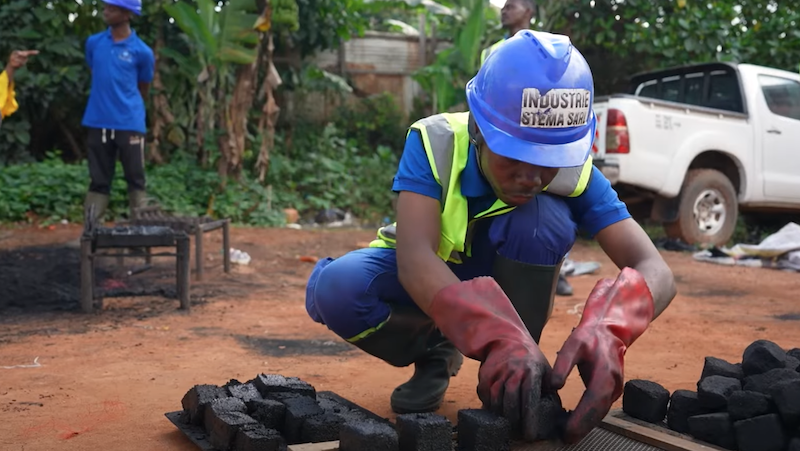
In Cameroon, home to one of the largest forest massifs in Africa, the production of charcoal is a growing threat to the environment. However, one local engineer is turning waste into an opportunity, as explained in a November 2024 Mongabay video published in English and French.
To address the deforestation challenge, Steve Djeutchou transforms organic waste, such as banana peels, into a cheaper, ecological alternative to charcoal. While locally referred to as “biochar” or “biocharbon” in French, the product Djeutchou produces is more accurately described in English as “eco-charcoal,” a clean cooking fuel made from organic waste. This differs from biochar in the scientific sense, which refers to a fine-grained soil amendment used in agriculture. Through his company, STEMA Group, and a local network of suppliers, he estimates that up to 40 metric tons of biomass could be collected each day in Yaoundé.
“If we manage to provide a palliative solution for charcoal or firewood, it means that we have solved a real problem related to deforestation,” Djeutchou tells Mongabay. He hopes eco-charcoal will eventually replace charcoal, a major driver for cutting and burning of trees in Cameroon.
Currently, STEMA produces around three tons of eco-charcoal a month, which without increased capacity is insufficient to have the effect they hope for: between 2002 and 2020, Cameroon lost more than 700,000 hectares (1.7 million acres) of forest, according to Global Forest Watch.