

Four years ago, Mongabay launched the Y. Eva Tan Conservation Reporting Fellowship to train and publish some of the most promising emerging environmental journalists in biodiversity hotspots around the world. It has grown substantially in 2026, with new offerings in different languages and an expansion of our global English-language program. In the latter, we are thrilled to welcome our largest cohort to date, with 11 fellows from 10 countries in Asia, Africa and Latin America.
The fellows are already hard at work, reporting stories ranging from new hope for the Indus River dolphin to public health risks of secondhand clothes and a school that turns cattle dung into biogas. During the six-month program from June 1 to November 30, 2026, each fellow is working on six assignments while concurrently attending online trainings in reporting, editing, multimedia, climate science and an array of critical environmental issues.
Some Y. Eva Tan Fellows come to the program entirely new to journalism. Others have reported for several years but never had training to equip them for covering conservation and science. All of them join with clear goals and enthusiasm for this work. Many former fellows have since gone on to become leading environmental journalists in their regions. We look forward to watching all of their careers evolve.
Partway through the 2026 global English-language cohort, we asked the fellows to share a brief statement on their thoughts about the program so far, and their hopes for the future. Please join us in welcoming the fellows, and take a moment to savor the voices of this next generation of environmental journalists.
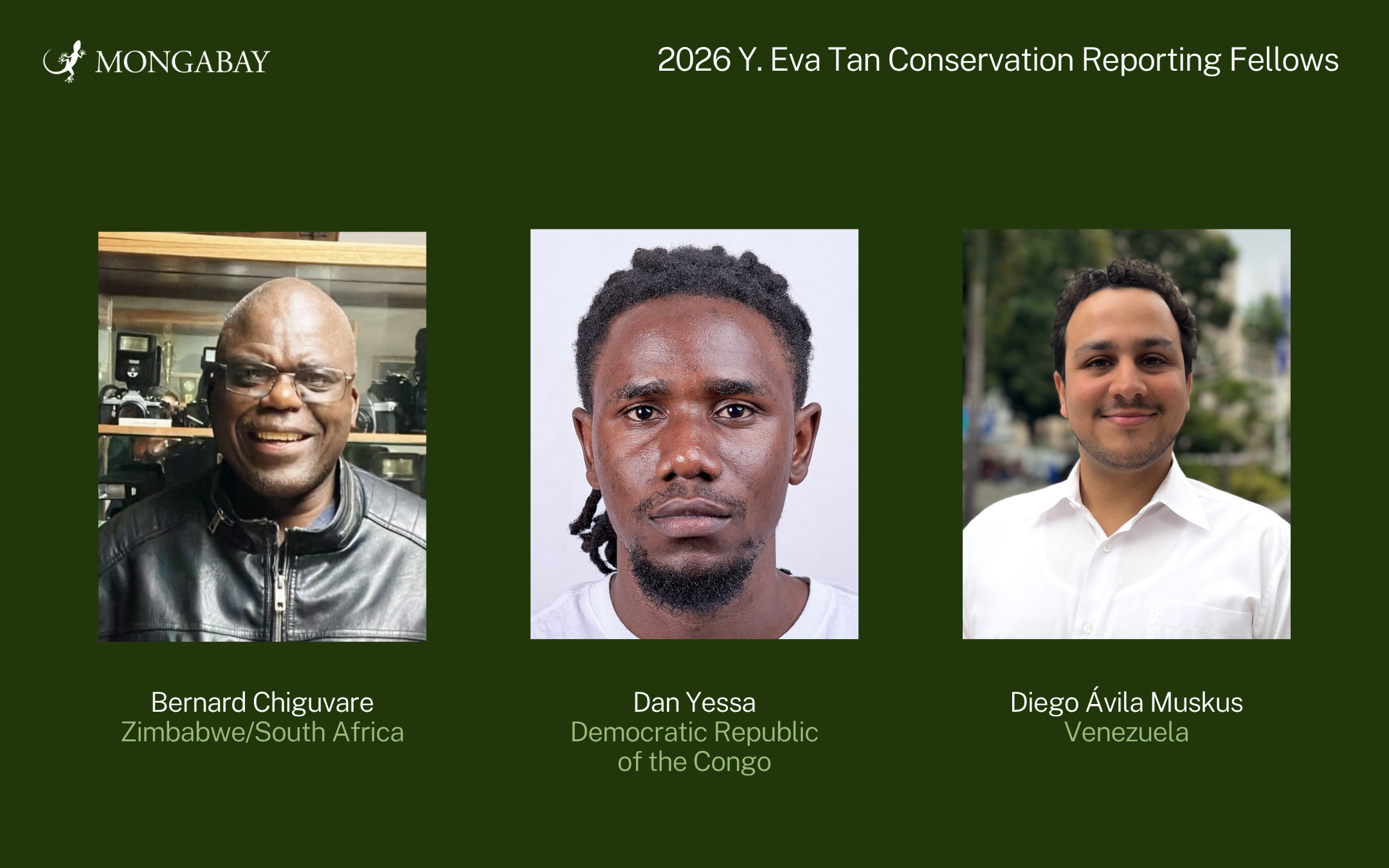
Bernard Chiguvare (Zimbabwe/South Africa)
“The fellowship … has given me the chance to develop a stronger environmental journalism identity, learn from experienced editors and become more confident in taking ownership of my work. My goal is that, by the end of the fellowship, I will not only have produced stronger environmental stories but also have established myself as a journalist who can be trusted to report on environmental and conservation issues across Africa.”
Read his profile and follow his Mongabay work here.
Dan Yessa (Democratic Republic of the Congo)
“A few years ago, when I first started my journey on LinkedIn, I honestly had no idea where my professional life was going. I knew one thing: I wanted to be part of the change happening around conservation in Africa. … Then, one day, I stumbled upon an opportunity to learn environmental storytelling and writing with Mongabay. That opportunity came at exactly the right time. At the time, I was dreaming of documenting conservation efforts across the Congo; not only through film, but also through writing. I even imagined turning some of those expeditions into a book one day. So I joined the fellowship. I learned. I wrote. I struggled with words. I rewrote. And eventually, I published my first-ever article with Mongabay.”
Dan writes that he wants “to be part of the change happening around conservation in Africa.”
Read his profile and follow his Mongabay work here.
Diego Ávila Muskus (Venezuela)
“Thanks to the Y. Eva Tan Fellowship from Mongabay, I’ve been able to join a network of journalists with a wide variety of perspectives, experiences and knowledge, but all with a common goal: to tell human, relevant and timely stories about the challenges threatening our planet and our communities. … In addition, I’ve been able to expand my knowledge in technical areas that are difficult to navigate without mentors, such as geographic information systems and data visualization.”
Read his profile and follow his Mongabay work here.
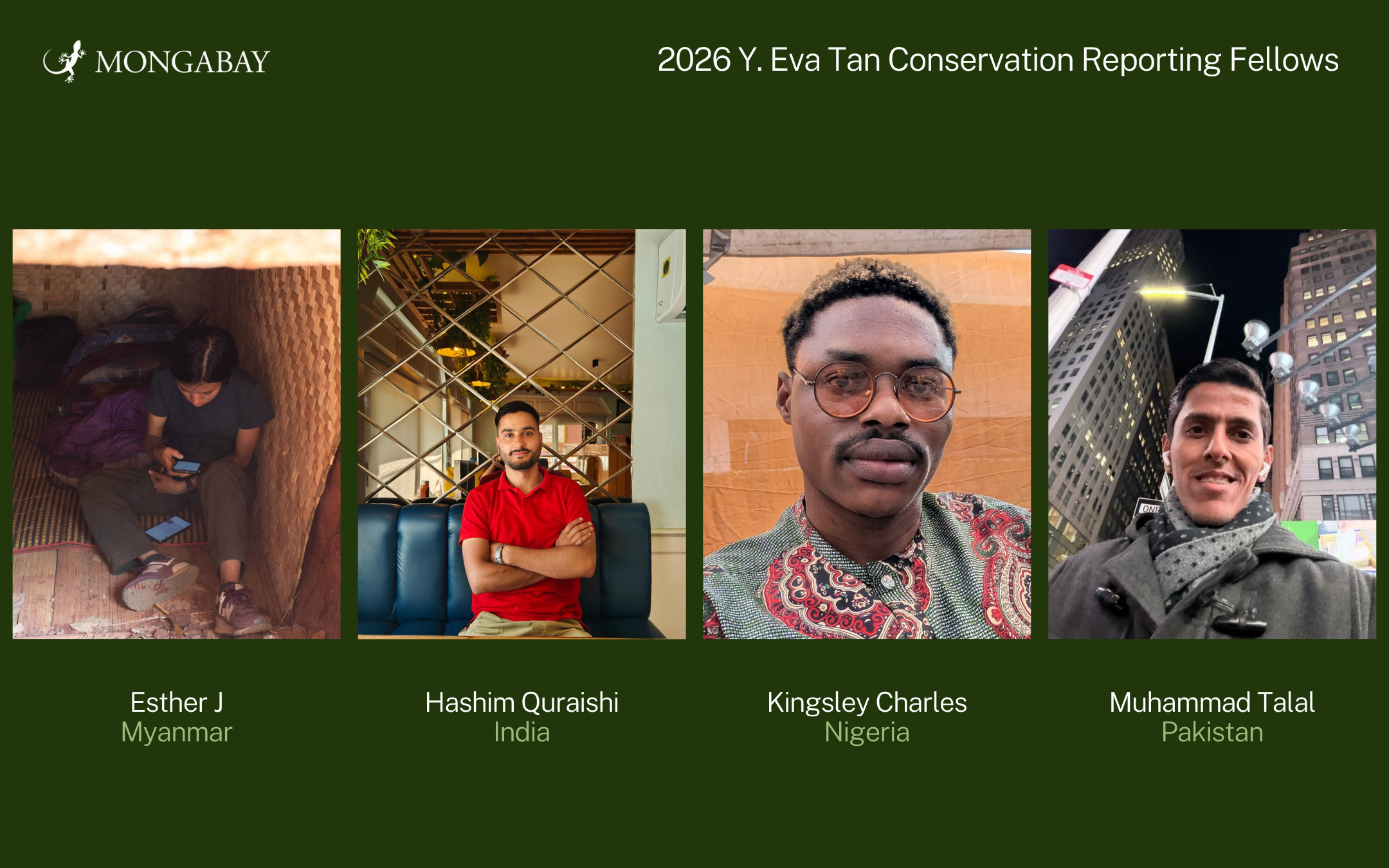
Esther J (Myanmar)
“Through this fellowship, I have already learned how to write stories based on scientific articles, how to turn the scientific environmental studies into interesting stories for general audiences and where to find resources for environmental research. … Through this fellowship, I have also had the opportunity to meet and connect with experts in environmental journalism and scientists working on various environmental issues, which is extremely valuable for my future career.”
After the fellowship, Esther says she plans to report on a wide range of environmental issues across Southeast Asia, with particular focus on gender, wildlife, rivers and oceans.
Read her profile and follow her Mongabay work here.
Hashim Quraishi (India)
“One of the biggest things I’ve learned through a couple of assignments is the importance of going beyond science. A study can document environmental change, but the real reporting begins with asking what that evidence means on the ground, who is affected, whether conservation responses are working and what is preventing solutions from reaching the places that need them. That has changed the way I approach scientific research and reporting.”
Hashim says he’s particularly interested in examining how science, policy and community action intersect in conservation.
Read his profile and follow his Mongabay work here.
Kingsley Charles (Nigeria)
“When a friend recently remarked on my increasing enthusiasm for wildlife and biodiversity, I simply replied, ‘Blame it on Mongabay.’ As an early-career journalist, I had only the foggiest notion of science reporting prior to this fellowship. But my experience since June has been especially adventurous. Not only have I had to read studies on relationships between wild edible plants and food security, I’ve also had to consult scientists in Nigeria, where I’m based, about endangered birds like vultures — which was the focus of my first assignment.”
Kingsley says he also looks forward to producing video stories on flooding, endangered wildlife and deforestation.
Read his profile and follow his Mongabay work here.
Muhammad Talal (Pakistan)
“My primary professional goal during this fellowship is to refine my ability to tell high-impact environmental stories that resonate with a global audience. Being part of Mongabay’s incredible network of journalists has already broadened my perspective on how we can collaboratively cover urgent climate crises. … Learning to adapt my writing style, whether translating dense scientific studies into accessible news or coordinating with field experts on tight deadlines, has been invaluable.”
Talal says he plans to continue focusing on solutions-based reporting, diving deeper into topics such as habitat degradation and wildlife conservation.
Read his profile and follow his Mongabay work here.
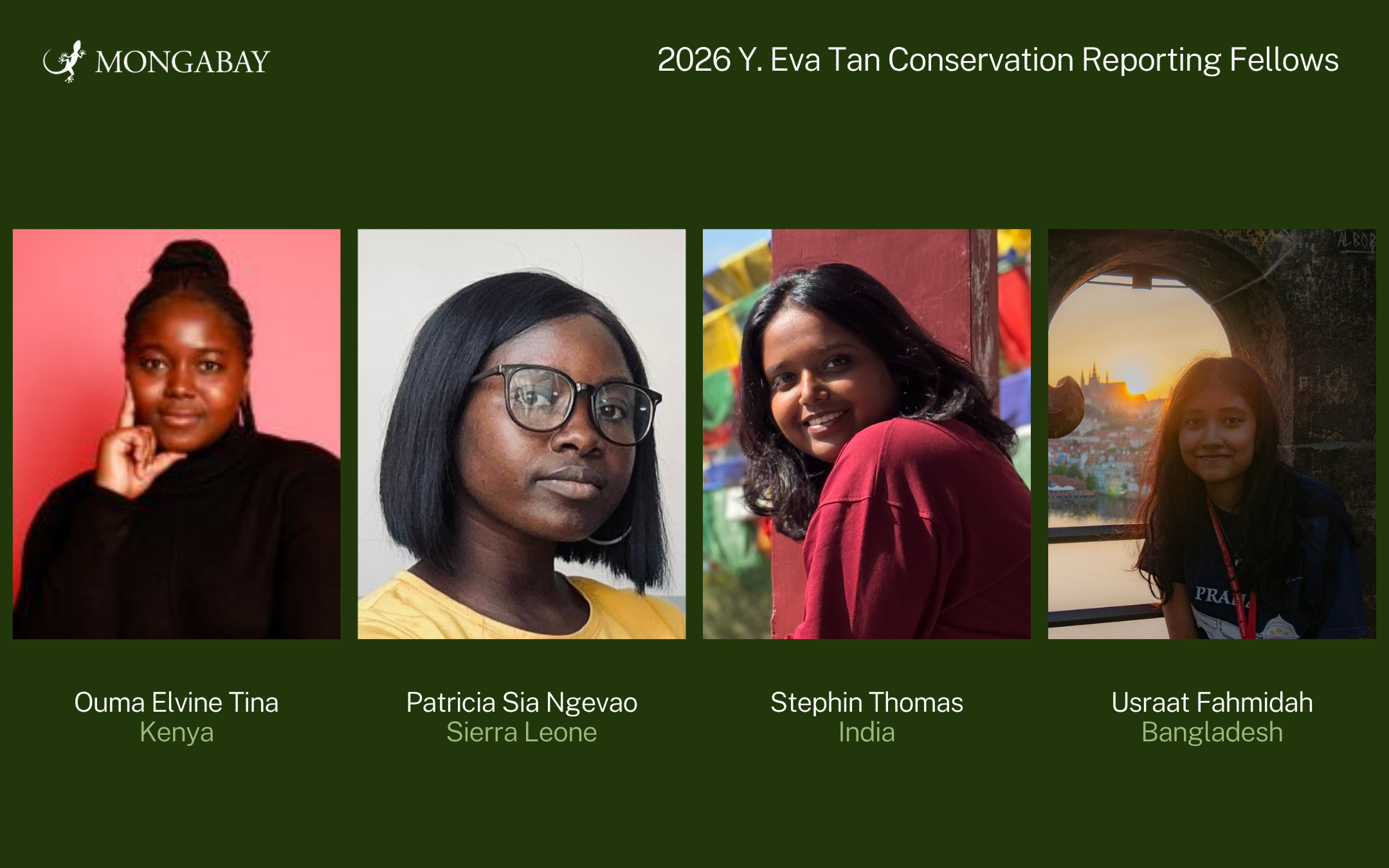
Ouma Elvine Tina (Kenya)
“In June 2023, after torrential floods had wrecked parts of Nairobi, I attended a focus group discussion in Kibera. Women shared intimate stories about how the floods had affected their lives. But they also spoke about extreme heat and what it meant to live in iron-sheet houses where the temperatures could become unbearable. … That conversation changed something for me. I began to understand that the environment was not some distant scientific subject. It was deeply connected to the issues I had already spent years reporting on: women’s health, violence, poverty, livelihoods, disability, labor and inequality. … I am beginning to realize that perhaps environmental journalism is a beat I can make my own. Honestly, it already is.”
Elvine continues, “I want my stories to make people pay attention, not only to environmental problems, but to the women already responding to them. And I hope that attention can become something more: conversations that lead to better funding, stronger journalism, more informed policy and, ultimately, more people caring about the environments we all depend on.”
Read her profile and follow her Mongabay work here.
Patricia Sia Ngevao (Sierra Leone)
“As a journalist in Sierra Leone, I want to use this fellowship to move beyond simply reporting environmental events and investigate the systems, policies and decisions that shape how people experience environmental change. … In the first two months, I have learned the importance of being more curious, looking beyond the obvious angle and taking the time to understand the people and issues behind a story. My assignments have also taught me the value of understanding the science, finding the right sources and making sure community voices are not lost in the reporting. I have learned to ask both soft and harder questions about who benefits, who bears the cost and whose voices are missing from the conversation.”
Sia says, “I want to explore stories that go beyond the obvious and look at how environmental decisions affect people in their everyday lives.”
Read her profile and follow her Mongabay work here.
Stephin Thomas (India)
“Being a Mongabay Fellow has been a truly transformative experience for my journalism. Having access to invaluable resources and learning alongside mentors and fellow journalists across different time zones has always been a dream of mine, and now I’m actually filing monthly stories with guidance of different mentors tailored to each piece.”
In addition, Stephin notes, “I will get to be part of the alumni network — that’s something that will be very helpful for me as a journalist.”
Read her profile and follow her Mongabay work here.
Usraat Fahmidah (Bangladesh)
“My goal for this fellowship has been to learn more about environmental journalism and become more confident in reporting environmental stories. I have especially benefitted from the training on science communication, which has helped me understand how to explain complex scientific topics in simple and accessible ways. It’s something I am still learning!”
Read her profile and follow her Mongabay work here.
Banner image: Snow leopard (Panthera uncia). Image by Julie Larsen © Wildlife Conservation Society.