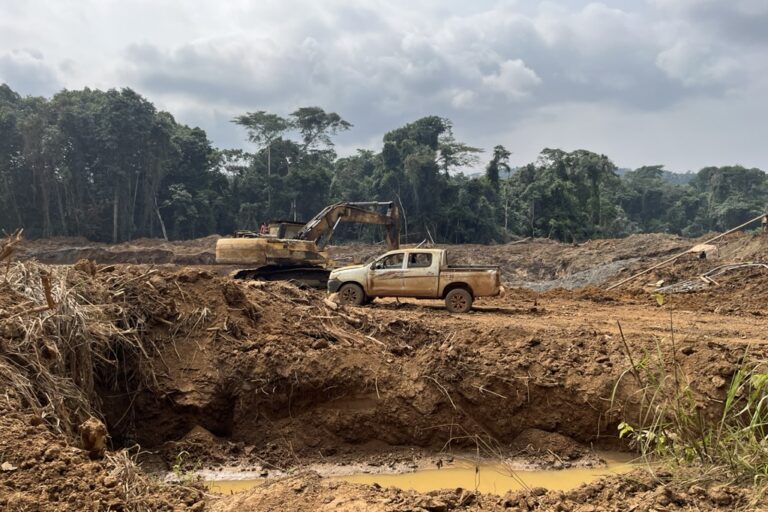
The reporting also examined the legal and policy context governing mining in the Sangha. While Congo’s mining code requires environmental impact assessments and land rehabilitation plans, the investigation revealed widespread degradation near mining sites.
Since the government launched the Sangha Likouala REDD+ program in 2020, an initiative intended to reduce deforestation and enhance carbon sequestration, the country’s Ministry of Mines issued at least 79 semi-industrial gold mining and exploration permits within the Sangha. This marks a sharp increase from the mere eight permits granted between 2017 and 2020, undermining the program’s goals.
This reality stands in stark contrast to the country’s international environmental image and to REDD+ programs intended to reduce deforestation and reward forest protection. By pairing visual evidence with expert analysis, Mongabay’s coverage underscored the tension between conservation goals and extractive development.
Impact
Following publication, Mongabay Africa’s video became a practical tool for organizations working with forest-dependent communities in the Sangha. A project officer at the Forest Peoples Programme (FPP) reached out to request permission to screen the Mongabay film within the local communities in which they work, including those impacted by gold mining, particularly in Messock, Elogo, Béthel, and Bamegoar, in the Souanké district.
“Given that we work with communities in the area where there is the impact of gold mining (…), we have the vocation to accompany these communities in self-determination in order to claim and denounce the illegalities related to the exploitation of their natural resources and the protection of their environment,” he said.
According to FPP, the screenings were intended to support community awareness and dialogue around REDD+, land tenure and extractive issues. The screenings later took place in these villages in April and May 2025. FPP reported that community members were happy and felt “seen” through the film.
Beyond community-level engagement, the reporting also helped elevate the issue in wider public discourse. Mongabay Africa staff writer Elodie Toto was also featured on TV5 Monde Afrique in late January to discuss her reporting, reflecting a broader trend in which Mongabay Africa is increasingly recognized as a leading source for stakeholders tackling environmental challenges across the continent.
This impact demonstrates how visual investigative journalism can extend beyond awareness to support action on the ground. By documenting the lived consequences of gold mining in a globally significant forest region, Mongabay Africa’s reporting became a resource for community dialogue, advocacy and empowerment.
Support independent environmental journalism
If you are interested in helping shed light on conservation issues such as this, there are two excellent ways you can do so with Mongabay. First, consider making a donation, which directly helps us continue to produce high-impact journalism from nature’s frontline. Second, subscribe to Mongabay’s newsletter to get the latest environmental news delivered right to your inbox, and share whatever articles move you with friends and family.
About Mongabay
Mongabay is a nonprofit environmental science and conservation news platform focused on providing original, reliable, and independent journalism from nature’s frontline. We pride ourselves on producing reporting that has substantial and tangible impacts around the world.
Banner image: Aristide, the village secretary of Bamegoard, stands dismayed as he looks over what was once a forest. Trees and streams have disappeared, replaced by muddy puddles like the one seen behind him. Image by Elodie Toto for Mongabay.