
How tapir toilets become buffets & boost global awareness of forest biodiversity via Mongabay

What looks like a pile of poop to some is a rich buffet to others, and a seed bank for some tropical forests’ futures. This is the story of how a recent Mongabay feature about lowland tapir latrines in Brazil revealed an underappreciated ecological asset and sparked widespread attention in the media and from Hollywood.

In July 2024, Mongabay published an article based on new research led by Laís Lautenschlager, a Ph.D. candidate at the University of Miami. The story explored how communal latrines created by lowland tapirs (Tapirus terrestris) in Brazil’s Carlos Botelho State Park are not only defecation sites, but key ecological hubs.

Using 27 camera traps between December 2021 and June 2022, the researchers observed 18 vertebrate species visiting the latrines. Among the most frequent visitors were Brazilian squirrels, which ate some seeds they found and cached others elsewhere (which might later germinate and grow into new trees).

The study also revealed several rainforest bird species frequenting these sites, including the near-threatened solitary tinamou. Interestingly, white-necked thrushes preferred to visit latrines several days after defecation, suggesting the dung piles serve as long-lasting food resources.

The study reaffirmed that tapirs support forest regeneration by dispersing seeds, but it went further by showing how their latrines also help feed other species, and it demonstrated an often-overlooked aspect of species interdependence in tropical forests.

Impact

After Mongabay published the story, it quickly gained unexpected traction. According to Paulo Brando, a tropical ecologist at the Yale School of the Environment and a senior author of a related study on lowland tapir seed dispersal in degraded Amazonian forests published by the journal Biotropica, the story drove “unprecedented attention” to the study, including a share on Instagram from actor and environmental advocate Leonardo DiCaprio. In addition, The Economist reached out to the researchers, citing Mongabay’s reporting.
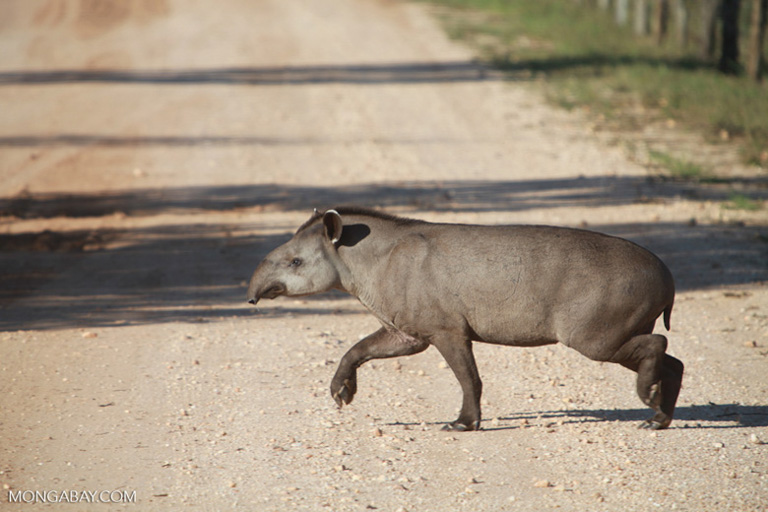
A lowland tapir crosses a road in Brazil. Image by Rhett A. Butler/Mongabay.

Brando estimated that the story reached millions of people, a scale of visibility rarely achieved for such niche ecological research. As a result, this attention elevated a lesser-known aspect of rainforest ecology to the global stage and highlighted the importance of lowland tapirs as ecosystem engineers. He contextualized this within Brazil’s broader reforestation mandate, where animals like tapirs may help reduce the cost of restoring millions of hectares of degraded land simply by doing what comes naturally to them: eating and dispersing seeds across landscapes.

Brando also shared that he hopes to publish new research on the topic soon. His team is currently testing the hypothesis that the type of crop in the matrix influences whether the results of tapirs’ seed dispersal will be large or small. “Our preliminary results suggest that some crops drive major shifts in tapir behavior, reducing their ability to disperse seeds,” says Brando.

The lead author of the study at the heart of Mongabay’s original story, Laís Lautenschlager, also noted meaningful outcomes from the feature’s visibility. “Mongabay’s article had a significant impact on my research in terms of advertising,” she said. “It definitely raised the interest of people inside and outside academia.” Colleagues, researchers, and even a zookeeper from the Paris Zoo reached out to discuss tapir behavior, and how communal latrines may be tied to social or reproductive functions.

The findings then also informed a recent talk at a workshop organized by Brazilian biologist Dr. Mauro Galetti at the study site, the Carlos Botelho State Park. The event shared their research with park staff and educators in support of outreach programs for schools, local communities, and tourists, says Lautenschlager.

Lautenschlager is now developing a follow-up study using DNA metabarcoding to examine the dietary preferences of lowland tapirs. By identifying the plant species in fresh tapir feces, the research will help uncover which zoochoric plants (species that rely on animals to disperse their seeds by eating their fruits) depend on tapirs for seed dispersal, and how this might contribute to forest regeneration in Brazil’s Atlantic Forest.

Support independent environmental journalism

If you are interested in helping shed light on conservation issues such as this, there are two excellent ways you can do so with Mongabay. First, consider making a donation, which directly helps us continue to produce high-impact journalism from nature’s frontline. Second, subscribe to Mongabay’s newsletter to get the latest environmental news delivered right to your inbox, and share whatever articles move you with friends and family.

About Mongabay

Mongabay is a nonprofit environmental science and conservation news platform focused on providing original, reliable, and independent journalism from nature’s frontline. We pride ourselves on producing reporting that has substantial and tangible impacts around the world.

Banner image: A South American or lowland tapir (Tapirus terrestris). Image by Allan Hopkins via Flickr (CC BY-NC-ND 2.0).