In July and August 2025, Mongabay published two investigative reports that uncovered the scale and opacity of shark meat purchases by Brazilian government institutions. These stories triggered immediate public and political responses, leading to a call for a parliamentary hearing, changes in school procurement policies, and a review of a federal ordinance that allows the sale of imported endangered shark species.
The first article published on July 29th revealed that Brazil, the world’s top importer of shark meat, is feeding much of what it buys to young children, hospital patients, military staff, public workers and more via government procurements. Some 5,900 public institutions — including homeless shelters, maternity wards, and elder care centers to name just three — were listed as possible shark meat recipients in over 1,000 government purchases. The species being acquired were nearly always unspecified, raising concerns among scientists and conservationists about the potential inclusion of endangered species.
Not only are sharks globally important for their role as a top predator in marine ecosystems, but the wide public consumption of their meat also exposes infants and other vulnerable groups in Brazil to high levels of heavy metals like mercury and arsenic, which accumulate in their flesh, and can harm human health.
Then the second article published on August 7th revealed that many tons of endangered angelshark had been purchased for public institutions in the Brazilian state of Rio Grande do Sul. Mongabay reporters identified 52 large purchases totaling more than 211 metric tons of “peixe anjo” (“angel fish”) – a common and misleading name for angelshark in the state – ordered by city and state administrations since 2015. Some procurement officers admitted they were unaware this label referred to a kind of shark when queried by the reporters.
As endangered species in Brazil, angelsharks can’t be caught there, but imported specimens can be traded legally. Brazil’s environmental agency, IBAMA, had already advised the environment ministry to close this exemption, which some call a loophole, but after Mongabay requested comments on past procurements, the state government and two municipal administrations said they would avoid buying angelshark in the future.
Impact
These investigations, which came at a time when the Brazilian government is reviewing its legal framework for the trade in sharks, set off a chain of reactions from lawmakers, institutions, and environmental advocates, driving national debate and scrutiny of Brazil’s shark meat trade.
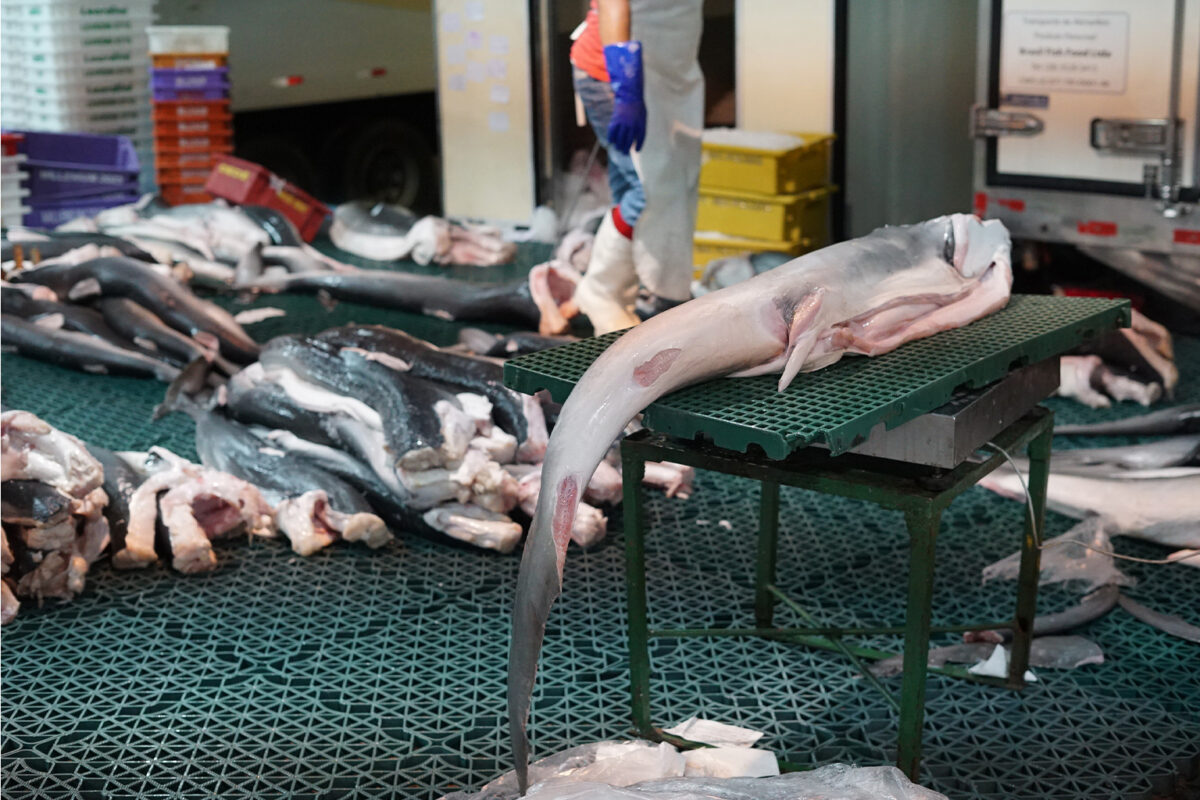
Shark meat is prepared for distribution at CEAGESP in São Paulo, the largest food warehouse in Latin America. Image by Philip Jacobson/Mongabay.
We are nonprofit.
Help us tell stories of biodiversity loss, climate change & socio-environmental injustice.
A Brazilian lawmaker called for a parliamentary hearing after the investigation’s findings were released. This leader of the environmental caucus in Brazil’s lower house of Congress said he was “shocked” at the scale of the purchases. “We can’t accept it,” said Nilto Tatto, a member of the Workers’ Party representing São Paulo state. Tatto said he would send Mongabay’s investigation, which includes a database of shark meat orders, to all federal agencies involved in food procurements, requesting they cease any shark meat purchases.
The Ministry of the Environment also responded: on Aug. 20, just three weeks after the first story was published, the ministry told Mongabay via an emailed statement that it would review “the possibility of including new related guidelines, including on the consumption of some species.”
Furthermore, at a Sept. 3 meeting, the National Environmental Council (CONAMA), a government advisory body, recommended the government ban shark fin exports and restrict the use of shark-fishing gear known as wire leaders. In his statement (livestreamed), José Truda Palazzo Junior, CONAMA member and founder of the Humpback Whale Institute and co-author of the motion, cited Mongabay’s July investigation.
“In recent months, Brazil has been exposed internationally in a series of reports, including on the world’s largest environmental news portal, Mongabay, which were reproduced in Brazil by Folha de S.Paulo [newspaper], ((o))eco [news portal], and several other media outlets, fully exposing the total chaos in which commercial shark exploitation in Brazil finds itself,” Truda said. “This directly impacts our international commitments, which we have been undertaking in the areas of marine biodiversity and even climate, given the proven importance of top predators in maintaining the ocean’s carbon cycle.”
Mongabay’s investigation also was cited as part of a class-action civil suit to ban federal public institutions from issuing tenders to purchase shark meat. In a hearing on Sept. 3, Nathalie Gil, director of conservation NGO Sea Shepherd Brasil, which originally filed the suit in December 2024, described Mongabay’s revelations, including the database of municipal and state public procurement tenders, which is now recorded in the hearing transcript in the case file, she said.
[January 2026 update] Rio de Janeiro state education department announced a ban on serving shark meat in public schools it manages, as did the municipal governments of Petrópolis and Cabo Frio. The city of Maricá (population 224,000) then responded to the team’s findings, too, saying that they have stopped serving shark meat “precisely due to concerns about the environment and children’s health,” both of which were points raised by the report.
Institutional
The reporting also resonated with school food authorities. Solange Bergami, president of the school food council of Duque de Caxias, a city in Rio de Janeiro’s metropolitan area, said she would share the investigation with her counterparts in other parts of Brazil. While Bergami has spent years trying to get shark meat removed from school meals where she lives, she said “many people were surprised” to learn the procurements were so widespread across the country.
Sandra Helena Pedroso, adviser to another such council of Rio de Janeiro state, referenced the investigation in a July 30 meeting of the National Forum of School Feeding Councils, known as FNCAE. “I appeal here to the councilors — take note, look closely at the menu, what is being served, whether it is actually suitable, whether there are any restrictions,” Pedroso said at the meeting.
Brazil’s National Fund for Education Development, the FNDE, which oversees the National School Feeding Program, also told Mongabay that it would look into concerns over heavy metals in shark meat.
NGOs and scientists
The revelations also drew swift responses from conservation groups. “The shark meat trade is larger and more damaging to the survival of these ancient ocean predators than anyone has previously realized,” Luke Warwick, director of shark and ray conservation at the Wildlife Conservation Society, wrote in an email after reading the investigation. “We are only now getting a true understanding of its scale and scope.”
Catarina Abril, a fisheries and climate officer at Portuguese NGO Sciaena, reacted to the story by saying the numbers presented in the article were “staggering.” And Gilles Hosch, a fisheries expert who worked on a 2022 report about the shark trade for the NGO Oceana, said that he was “genuinely stunned” to learn Brazil was a top shark meat consumer, and also noted that the large public procurements were not on his radar.
Media amplification
The first article was also republished by leading Brazilian outlets Folha de S.Paulo and ((o))eco, and has since been cited by other national media, including Estadão and Rádio Eldorado. And in an Eldorado radio segment, Sea Shepherd representative Nathalie Gil referenced the findings, further fueling public awareness.
The popular public radio show “The World,” which is heard daily on hundreds of stations across the U.S., interviewed one of the reporters about the findings, and additional interviews of the reporting team for podcasts and public radio are forthcoming.
Support independent environmental journalism
If you are interested in helping shed light on conservation issues such as this, there are two excellent ways you can do so with Mongabay. First, consider making a donation, which directly helps us continue to produce high-impact journalism from nature’s frontline. Second, subscribe to Mongabay’s newsletter to get the latest environmental news delivered right to your inbox, and share whatever articles move you with friends and family.
About Mongabay
Mongabay is a nonprofit environmental science and conservation news platform focused on providing original, reliable, and independent journalism from nature’s frontline. We pride ourselves on producing reporting that has substantial and tangible impacts around the world.
Banner image: The blue shark is one of the widest ranging sharks in the world, and its meat is the most commonly traded in commercial markets. Image by Prochym / Adobe Stock.
Stay updated
Delivering news and inspiration from nature’s frontline.