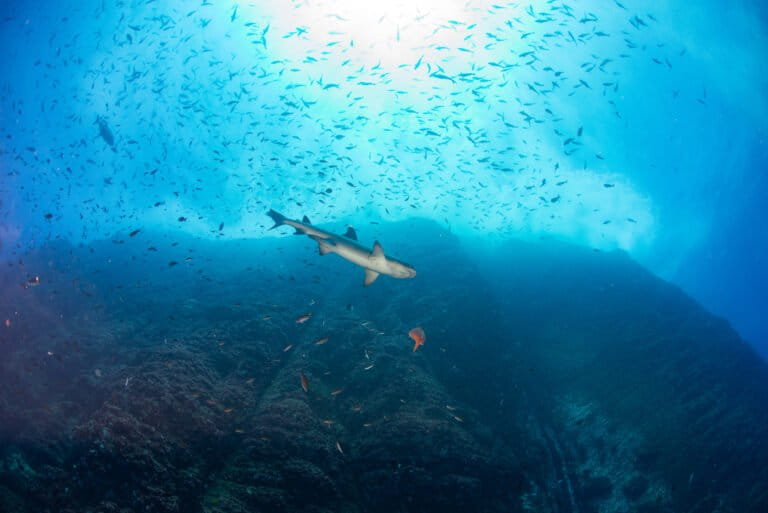
In early April 2025, Mongabay Latam published a Spanish-language investigation into suspicious fishing activity inside Mexico’s Revillagigedo National Park, the largest marine reserve in North America and a UNESCO World Heritage site. The report revealed that a U.S.-flagged sportfishing vessel had been detected operating inside the strictly protected area, where all fishing has been banned since 2017.
According to scientists, the boat had repeatedly entered Revillagigedo since 2012, years before it was declared a national park. On January 29, crew members of the boat posted photos on social media showing them catching yellowfin tuna, with dates that coincided with the vessel’s incursion into the park. Illegal fishing by sport boats in the area is not new, yet Mexican authorities had so far reported no sanctions on such operators.
Mongabay’s coverage drew on satellite data and expert analysis from scientists at the Centro para la Biodiversidad Marina y la Conservación (CBMC), a research group in La Paz, and the Scripps Institution of Oceanography near San Diego. Their teams documented incursions in January and March 2025, using both Skylight and Global Fishing Watch, tools that track vessel movements at sea in near real time.
According to their findings, the boat switched off its Automatic Identification System (AIS) — a satellite- and VHF-based tracking system commonly used by ships — upon entering the park, in a maneuver often linked to illegal fishing. The vessel only reappeared in AIS logs days later, once the boat’s system was turned back on. The investigation further revealed that this was not an isolated incident: other unidentified vessels without AIS signals were also observed operating in the area.