
Reporting on illegal Vietnamese fishing prompts Indonesian law enforcement actions & dialogue

Independent journalism plays a vital role in highlighting underreported environmental issues and empowering affected local communities. Take for example Mongabay Indonesia, which published a March 2025 report amplifying the voices of small-scale fishers from Natuna and Anambas in Riau Islands province, whose harvests faced growing threats from foreign fishing vessels – particularly from Vietnam – operating illegally in their home waters of the North Natuna Sea. 

This foreign fleet was observed to be damaging their livelihoods, and the report documented how large Vietnamese trawlers were alleged to be destroying bubu, a kind of fish trap used by local fishers, with losses estimated at hundreds of millions of rupiah. The local people also described approaching the foreign vessels and requesting that they leave, but their pleas were ignored, highlighting the powerlessness of local people to stop these illegal incursions.

The article also detailed how local fishers were losing a significant portion of their catch: one shared that 20 traps typically yielded a ton (over 2,200 pounds) of fish, but after instances of illegal fishing, only 200 kilograms (441 pounds) typically were harvested. This is an amount insufficient to cover the local fisher’s operating costs.

The report went further by exploring fishers’ frustrations with a perceived lack of patrols by Indonesia’s maritime authorities. Officials from the Directorate General of Marine and Coastal Resources Supervision (PSDKP) acknowledged that limited budgets had hampered their surveillance efforts, while the Maritime Security Agency (Bakamla) declined to comment on the situation at all, heightening concerns among fishers about weak enforcement.

Impact

After its publication, the PSDKP responded, saying that Mongabay Indonesia’s reporting was of great assistance, especially in documenting the presence of foreign vessels operating in Indonesian waters. A few days later, DKP also invited several related stakeholders, including the marine police unit, to follow up on the findings, and authorities then arrested the crews of some foreign vessels operating in the area.

Following this initial response, Mongabay consistently reported throughout 2025 on illegal fishing and maritime governance issues in the North Natuna Sea, such as this follow-up article, which sustained ongoing public attention on the issue.
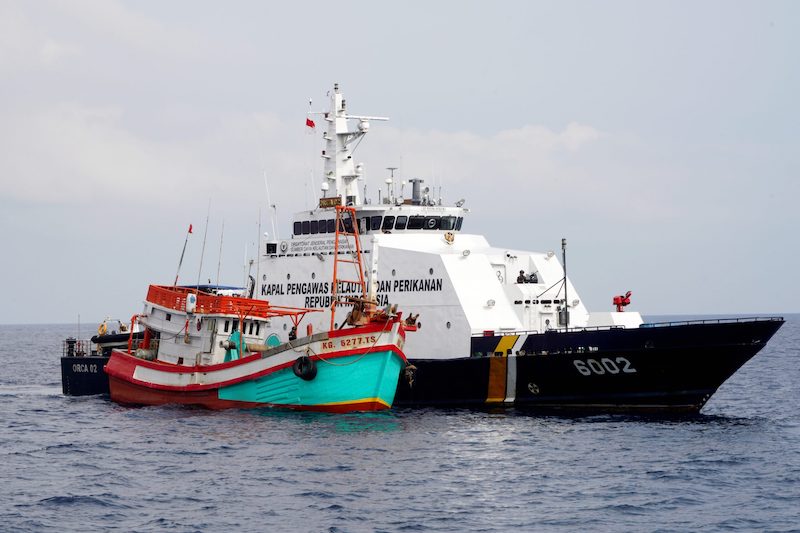
The process of securing a Vietnamese foreign fishing vessel (KIA) by an Indonesian patrol boat. Photo: PSDKP.

Then in December 2025, all of this reporting led to new engagement beyond enforcement actions. Yogi Eka Sahputra, the Mongabay Indonesia journalist covering these issues, was invited to participate in a public screening of the documentary “The Sea Guardian,” and a panel discussion at Universitas Internasional Batam focused on marine conservation, Indigenous peoples’ empowerment and maritime governance. The forum brought together legal scholars, researchers, and senior representatives from Indonesia’s maritime and fisheries authorities, including officials from the Ministry of Marine Affairs and Fisheries and from the marine security agency, Bakamla.

The invitation positioned Mongabay’s investigative reporting within a formal academic and policy dialogue, allowing its field-based findings to inform discussions of ongoing challenges in the North Natuna Sea. Combined with the enforcement actions, this engagement reflects how sustained environmental journalism can extend its impact beyond immediate responses, contributing to longer-term institutional awareness of persistent governance issues.

This case also illustrates how timely, evidence-based reporting can support coastal communities on the frontlines of illegal, unreported, and unregulated fishing. By elevating fisher voices and drawing national attention to maritime sovereignty and conservation concerns, Mongabay’s reporting helped catalyze action from the relevant authorities, demonstrating the extensive ability of journalism to defend local livelihoods and marine ecosystems.

Support independent environmental journalism

If you are interested in helping shed light on conservation issues such as this, there are two excellent ways you can do so with Mongabay. First, consider making a donation, which directly helps us continue to produce high-impact journalism from nature’s frontline. Second, subscribe to Mongabay’s newsletter to get the latest environmental news delivered right to your inbox, and share whatever articles move you with friends and family.

About Mongabay

Mongabay is a nonprofit environmental science and conservation news platform focused on providing original, reliable, and independent journalism from nature’s frontline. We pride ourselves on producing reporting that has substantial and tangible impacts around the world.

Banner image: Orbicular batfish on a reef offshore of Komodo, Indonesia. Photo by Rhett Butler/Mongabay.