
Reporting sparks interest in solar-powered agriculture across Africa

Given that agriculture employs more than 60% of Africa’s workforce, experts emphasize boosting energy access as a critical input to enhancing productivity and food security. On this front, Mongabay’s reporting on the growing role of solar energy in smallholder agriculture has helped catalyze action, from inspiring NGOs to implement similar solutions to being used as a knowledge-sharing tool for clean energy development across the continent.

In March 2025, Mongabay published a report highlighting how smallholder farmers across Rwanda are increasingly adopting solar-powered irrigation systems to adapt to climate change, increase crop yields, and reduce dependency on costly diesel generators. The article showcased real-life examples, such as Rwandan farmer Victor Ndwaniye, who said that his crop yields tripled after switching to solar irrigation. It also spotlighted regional efforts supported by the World Resources Institute and national governments to integrate renewable energy across agricultural value chains, from irrigation to cold storage to market transport.
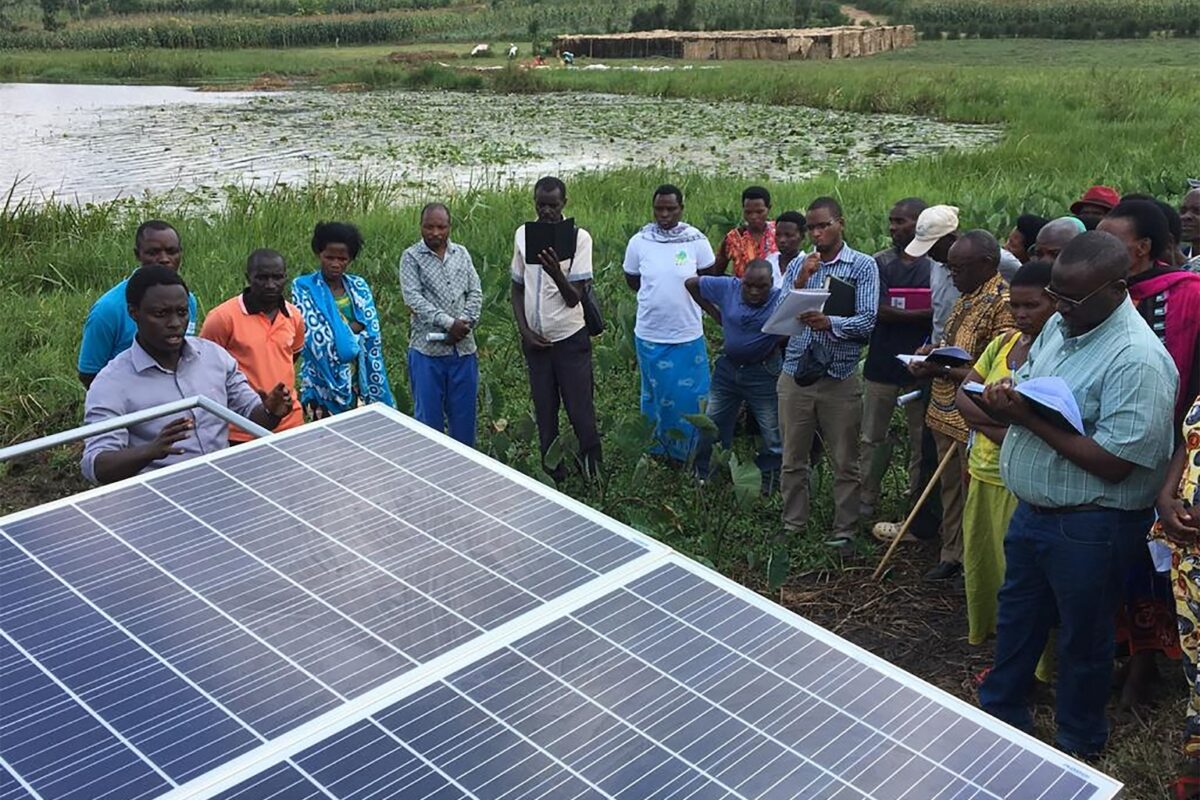
Solar irrigation systems offer a renewable and cost-effective energy source for farmers, reducing reliance on traditional power sources like here in Gatsibo, a district from Eastern Rwanda. Image by Aimable Twahirwa.

Innovative solar-powered irrigation systems are becoming important job creators in Africa. Yet, the capital investment required to adopt the technology remains a major hurdle for many smallholder farmers.

Impact

Since publication, the story has prompted some other stakeholders to reflect on decentralized solar energy as a viable and scalable solution for addressing agricultural and energy challenges across Africa. According to Mongabay Africa staff writer Aimable Twahirwa, the story inspired NGOs to begin considering similar renewable energy solutions. For example, the Zimbabwean NGO Score Against Poverty is now evaluating how solar-powered irrigation might serve the 18,000 rain-fed smallholder farmers it works with across Zimbabwe and Ethiopia. The organization is exploring the feasibility of adapting these solutions and seeking partners and funding to support this transition.

The article has also gained traction beyond the nonprofit sector. It was featured by Sun-Connect News, a global platform dedicated to decentralized solar development in Africa, and shared on Access Agriculture, which supports agribusiness and rural development through knowledge exchange.

This example illustrates the role of Mongabay’s independent journalism in accelerating access to evidence-based solutions. By documenting locally grounded yet scalable innovations, Mongabay’s reporting helps empower communities and inform efforts to address the future of energy and agriculture in Africa.

Support independent environmental journalism

If you are interested in supporting more impact-driven journalism like this, there are two excellent ways you can do so with Mongabay. First, consider making a donation, which directly helps us continue to produce high-impact journalism from nature’s frontline. Second, subscribe to Mongabay’s newsletter to get the latest environmental news delivered right to your inbox, and share whatever articles move you with friends and family.

About Mongabay

Mongabay is a nonprofit environmental science and conservation news platform focused on providing original, reliable, and independent journalism from nature’s frontline. We pride ourselves on producing reporting that has substantial and tangible impacts around the world.

Banner image: A farmer from Kirehe, Eastern Rwanda using a solar-powered irrigation system. Image by Aimable Twahirwa.