On December 2, 2014, a company launched an initial public offering (IPO), portraying itself to investors as a force for positive change in the chocolate industry, raising $10 million in its first month on the London Stock Exchange’s AIM market and with the goal of being the world’s largest grower of sustainable cacao. Its Tamshiyacu plantation near Iquitos, Peru, was claimed to be a model project, having been established on degraded land that had been farmed since the late 1990s, rather than at the expense of primary rainforest, a spokesperson told Mongabay: “There was no high-conservation-value forest on that land,” the representative said.
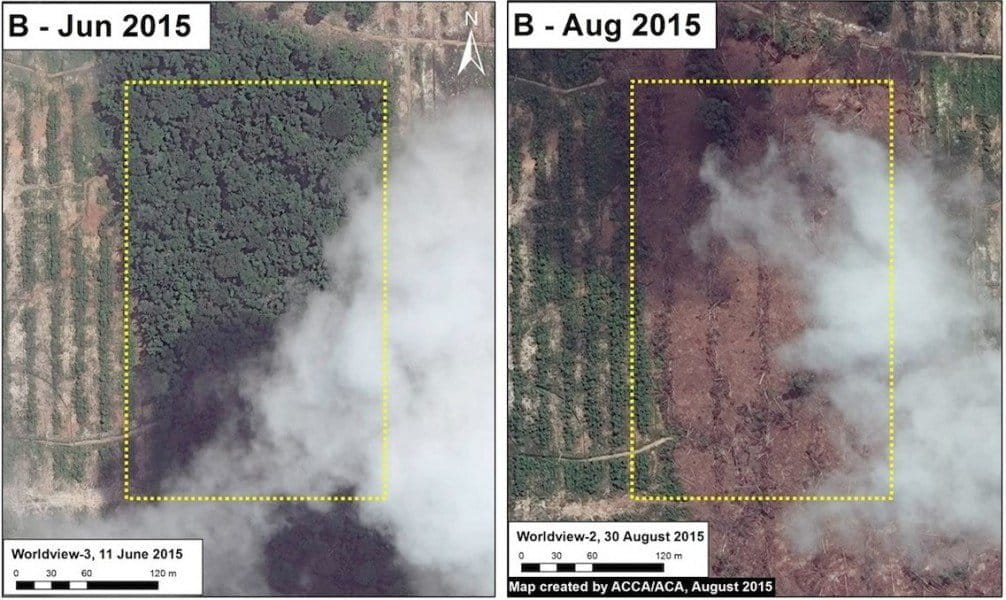
But ongoing analysis of satellite imagery of the plantation contradicted that narrative, as was first reported by Mongabay in January 2015. The investigation revealed that the company had in fact cleared more than 2,000 hectares (5,000 acres) of primary, closed-canopy rainforest in 2013. Critics said the case mirrored palm oil industry practices in Southeast Asia, as it undermined sustainability claims, threatened local livelihoods and risked normalizing large-scale deforestation in the Amazon.
The company denied the findings and attempted to block publication of the findings by threatening a libel lawsuit. But Mongabay proceeded and for the next several years, the team continued to investigate and publish reporting on the unfolding environmental, legal and financial consequences of the cacao company’s operations in Peru.
A week later, a follow-up from Mongabay revealed the company had continued operations despite a government order to halt clearing in December 2014. Investigations then tied its CEO to companies controlling over 45,000 hectares (over 111,000 acres) of land, much of it intact primary forest, raising concerns about further large-scale deforestation. Despite government sanctions, company representatives told investors it owned 3,523 hectares (8,700 acres) and planned to expand beyond 4,000 (nearly 10,000 acres) by the end of 2015, without mentioning the cessation order in its official documentation.
In April of that year, a regional court in Loreto, Peru, ruled the clearing was legal, dismissing the Forestry Department’s claim that prior approval was required. The Ministry of the Environment announced plans to appeal, as experts highlighted contradictions in Peru’s forest and land-use laws – which allowed agricultural classification of forested land despite legal protections for standing forests – inconsistencies that one source said are exploited by plantation companies like this one at the heart of Mongabay’s reporting.
By September 2015, new satellite imagery showed that clearing had accelerated despite the suspension injunction, yet a spokesperson insisted the company was acting within its legal rights.
2016
In March of that year, Mongabay revealed that the company had continued cutting primary forest on the Tamshiyacu plantation throughout 2014, violating the government suspension from earlier in that year and bringing the total area of cleared land to nearly 2,400 hectares (almost 6,000 acres) since the project began in 2013.
Then in May, conservation and Indigenous organizations filed a petition to have the company delisted from the London Stock Exchange, alleging that the firm had misled investors and broken market rules. Mongabay reported on the corporate response to this campaign and then in July, the team revealed that the plantation was built illegally on land zoned as forest – according to a new zoning evaluation that stated the land could never have been legally developed because its soil, climate, and topographic conditions made it suitable for forest – not agriculture.
2020 and beyond
In December 2020, a local court reversed an earlier ruling against cacao company employees, effectively absolving them of the crimes of illegal trafficking of timber products and aggravated obstruction of justice, and also overturned the civil reparation of 15 million soles (around $4 million), following what critics described as a ‘pressure campaign.’
Over a year later, in November 2021, Mongabay published news that a Peruvian court had dismissed a defamation case filed by the company against Mongabay Latam’s reporter, on the grounds of public interest and journalistic freedom.
In December 2021, Mongabay documented that the company had also targeted public prosecutors and environmental defenders in what lawyers said appears to be a pattern of intimidation.
Impact
The reporting played a central role in challenging the company’s false sustainability claims – which informed legal action and protected rainforest ecosystems in Peru from further deforestation – but Mongabay faced legal threats from the company after the initial article was published in 2015 and thereafter as the team continued its coverage. The ongoing release of new findings prompted other media outlets to investigate, inspired advocacy campaigns, and eventually brought national and international scrutiny to the case.
Then in January 2017, the company’s CEO and several other senior executives resigned, and trading of the company’s shares was suspended. Not long after, the company was formally delisted from the London Stock Exchange, depriving it of capital it needed to vastly expand operations, sparing an estimated potential of 100,000 hectares (over a quarter of a million acres) of rainforest from destruction. As a result, 29 million metric tons of carbon dioxide emissions were avoided, which is equivalent to more than half of New York City’s annual greenhouse emissions.
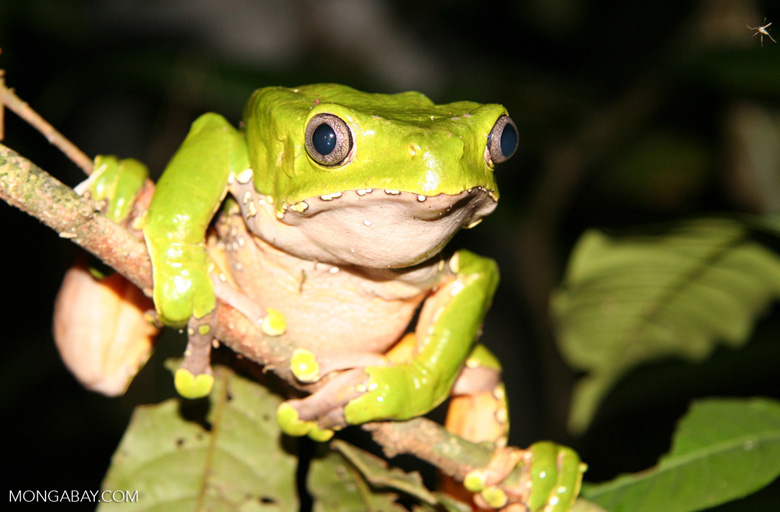
A monkey frog (Phyllomedusa bicolor), one of the many denizens of Peru’s rainforests. Photo by Rhett A. Butler.
Also noteworthy is that three staff members of the company’s wholly owned subsidiary in Peru were sentenced for illegal trafficking of timber products and aggravated obstruction of justice in 2019. Their sentences ranged from four to eight years, and the court ordered compensation paid jointly by the individuals sanctioned and the company during the first year of the sentence. The satellite imagery published by the investigation was used as evidence in the case – “the history in pictures of our forest” – according to Julio Guzmán Mendoza, the state attorney for the Ministry of the Environment.
After the suit against Mongabay Latam’s reporter was dismissed, the ruling was celebrated as a landmark case for press freedom in Peru: “This judicial resolution has a particular relevance because it constitutes the first decision that the Judiciary has issued on a case of an environmental journalist whose reporting on environmental crimes constitutes the exercise of freedom of information and speech,” said her lawyer, Carlos Rivera, who is a member of the Legal Defence Institute.
Support independent environmental journalism
If you are interested in helping shed light on conservation issues such as this, there are two excellent ways you can do so with Mongabay. First, consider making a donation, which directly helps us continue to produce high-impact journalism from nature’s frontline. Second, subscribe to Mongabay’s newsletter to get the latest environmental news delivered right to your inbox, and share whatever articles move you with friends and family.
About Mongabay
Mongabay is a nonprofit environmental science and conservation news platform focused on providing original, reliable, and independent journalism from nature’s frontline. We pride ourselves on producing reporting that has substantial and tangible impacts around the world.
Banner image:Deforestation on the plantation. Image by Diego Pérez.
Stay updated
Delivering news and inspiration from nature’s frontline.