

How do journalists decide what to report? What makes a story idea worth considering? And how can organizations, researchers, practitioners, and communities share information in a way that is clear, responsible, and useful?
Join Mongabay for our How Journalism Works series, a practical educational session designed to explain how independent environmental journalism operates and how sources can engage with journalists more effectively.
Participants will learn how to share story ideas, evidence, and context in ways that help journalists assess information clearly, responsibly, and safely.
This 1-hour live webinar will focus on:
- How Mongabay’s Global English newsroom assesses story ideas
- What makes information easier for journalists to understand, verify, and responsibly evaluate
- How evidence, context, uncertainty, and safety shape responsible outreach
- How to submit story ideas through the appropriate Mongabay channels
The session will touch on newsroom decision-making, story angles, evidence, source expectations, editorial independence, safety considerations, and the boundaries of the reporting process. It will also briefly discuss why Mongabay thinks about journalistic impact beyond traffic or clicks.
This is an educational webinar designed for people outside the newsroom who want to better understand how journalists work, avoid common outreach mistakes, and make their information easier to assess. It is not professional training for journalists, though journalists are of course welcome to join.
Journalists looking for Mongabay training resources can view Mongabay’s Webinars for Journalists series. Journalists can pitch stories aligned with Mongabay’s priority topics or regions via our Opportunities page.
The webinar will include a structured presentation followed by moderated Q&A. Participants will also be able to submit questions in advance through the registration form.
Participation does not influence Mongabay’s editorial decisions or guarantee coverage. The webinar will be general in nature and will not provide editorial or communications advice for any specific stories or organizations.
Upcoming session
This page is updated with upcoming sessions and resources from the ongoing How Journalism Works webinar series.
When: Tuesday, November 17, 2026, 13:00-14:00 UTC
Where: Live via Zoom
Register here to receive the Zoom link.
You can also subscribe to our How Journalism Works newsletter to receive updates about future sessions.
The hosts
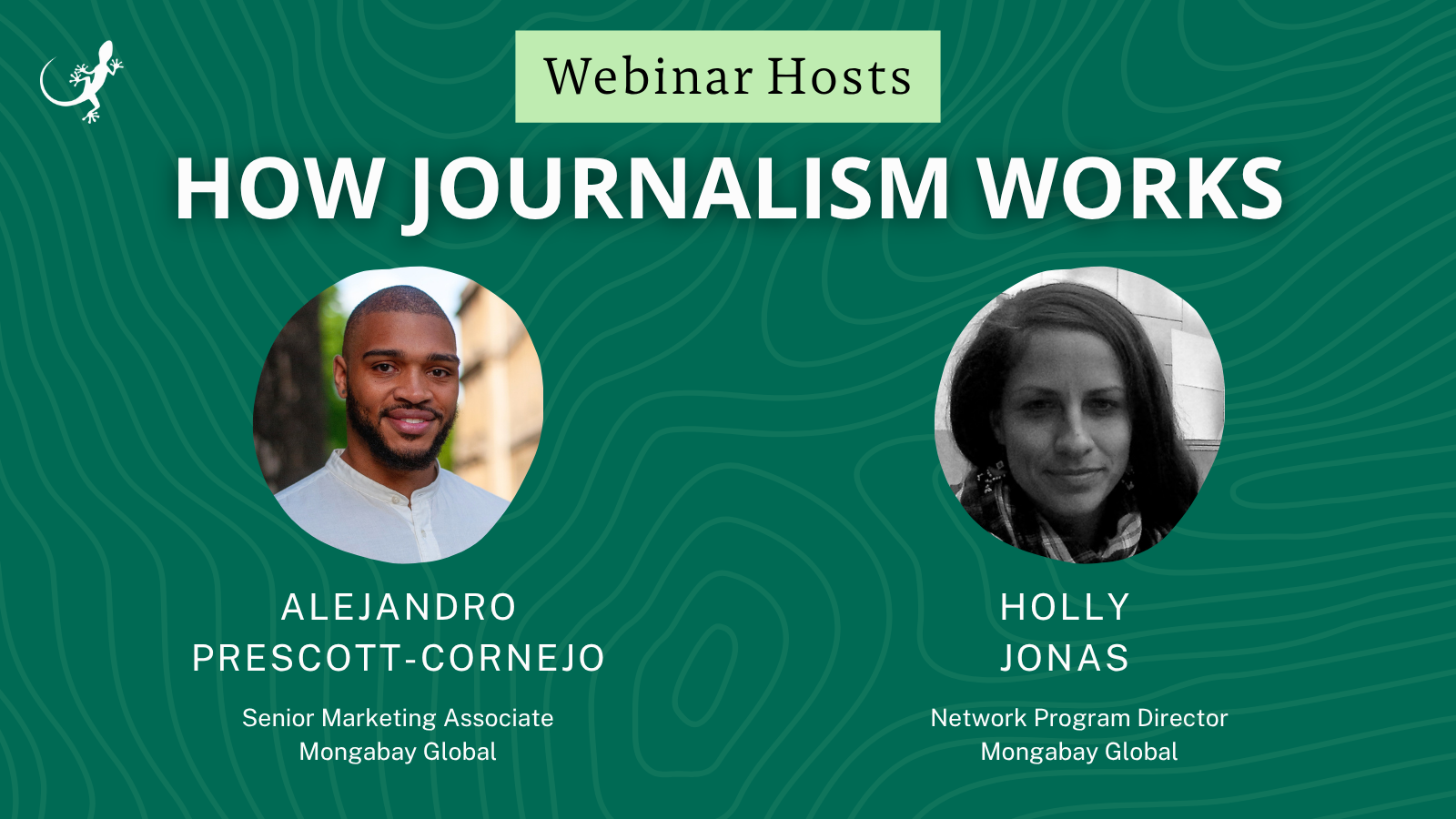
Live on Zoom, Mongabay’s Senior Marketing Associate Alejandro Prescott-Cornejo will lead the presentation, moderated by Mongabay Network Program Director Holly Jonas, and followed by a Q&A.
Alejandro Prescott-Cornejo
Alejandro Prescott-Cornejo is a Senior Marketing Associate at Mongabay, where he looks for creative ways to share independent environmental reporting to the people and communities who can use it. Outside of work, Alejandro is a wildlife photographer and helps others learn the craft through his blog, APC Wildlife Photography. He holds an MSc in Biodiversity, Conservation & Management from the University of Oxford and an Honours BA in Spanish & Portuguese Literature from the University of Toronto. His previous experience includes roles with Ottawa Riverkeeper, the European Commission and the University of Toronto.
Holly Jonas
With Mongabay’s Network Program, Holly oversees our fellowship and professional development opportunities for journalists, coordinates our engagement in events, and contributes to marketing and outreach, partnerships, and development. She has 20 years of nonprofit experience, focusing primarily on the nexus of human rights and nature conservation. She has an honours bachelor’s degree in zoology and anthropology, a master’s in public international law, and a certificate in multimedia journalism.
Resources
These resources are intended to help participants apply the ideas covered in the webinar:
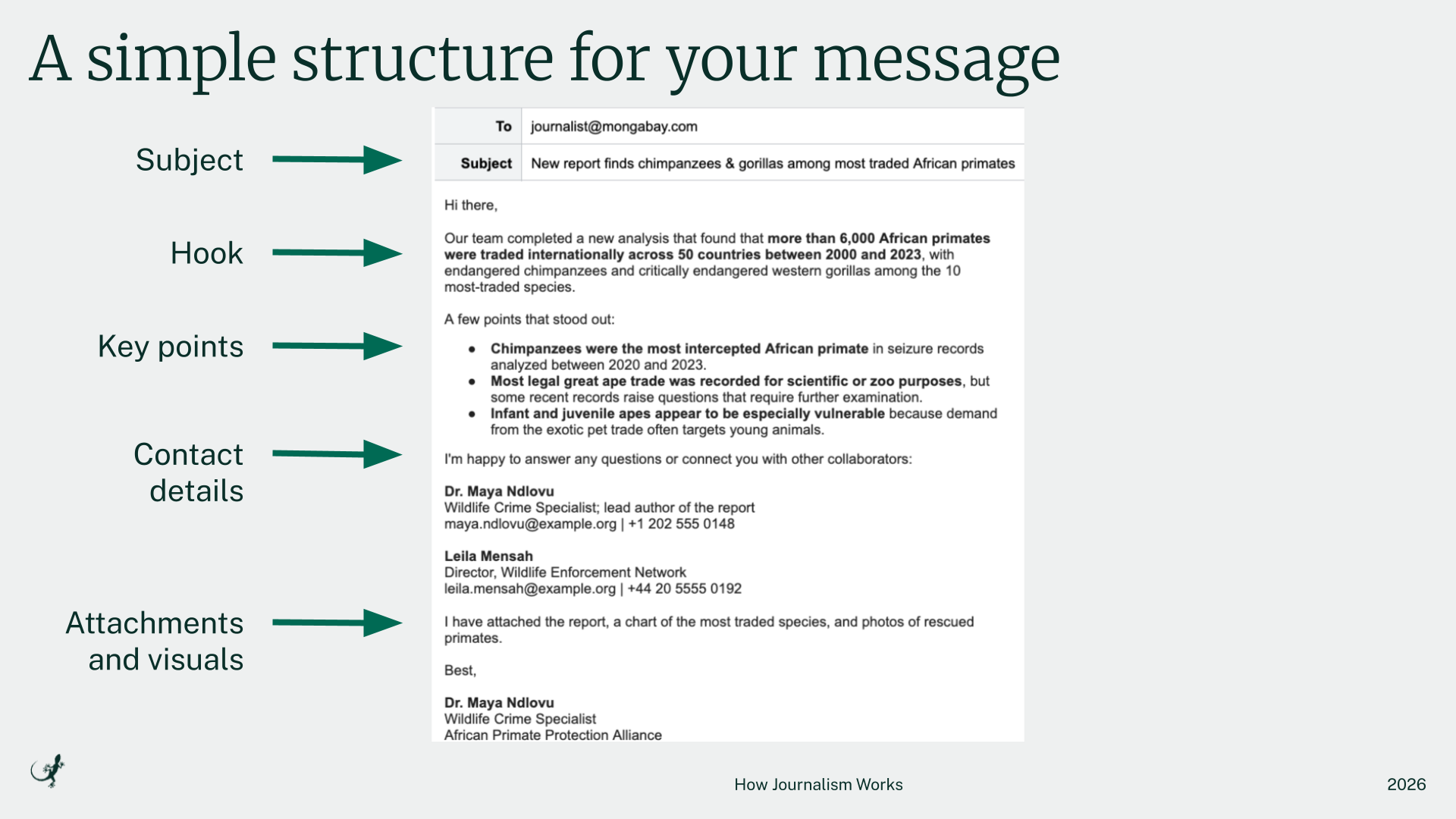
Sample email for contacting a journalist
Frequently asked questions
What is journalism?
At its core, journalism is the independent process of gathering, verifying and publishing accurate information in the public interest.
For Mongabay, that means reporting on nature and planetary challenges in ways that improve understanding, make science accessible, elevate the voices and knowledge of people directly affected by environmental change and create opportunities for accountability.
How is journalism different from communications or advocacy?
Journalists make independent editorial decisions about what to investigate, who to speak with, how to verify information, and what gets published. Sharing information with a journalist starts an editorial process, not a controlled communications process.
What makes a story idea useful to journalists?
A useful story idea is clear, specific, timely, and supported by evidence. It should explain what is happening, why it matters now, who is affected, what evidence exists, and who can speak about it.
What should I include when contacting a journalist?
Include a short summary of the story idea, the location or community involved, why it matters now, any evidence or data available, and contact details for people who can help explain the issue. Put the main information in the message itself, not only in links or attachments.
Why do journalists ask for evidence and context?
Journalists need to understand what claims are supported, where the information came from, what still needs to be checked, and what context may be missing. Clear evidence, plain language, and a note on any uncertainty make information easier to assess.
What should I consider before sharing sensitive information?
Think about whether sharing the information could put people, communities, locations, species, documents, or sources at risk. If confidentiality, anonymity, or safety is a concern, discuss ground rules with the journalist before sharing sensitive details.
Can I review a story before publication?
Sources do not review or approve stories before publication. Reporters may, however, confirm direct quotes, factual details, or technical information attributed to a source.
Does sharing information guarantee coverage?
No. Mongabay’s editorial decisions remain independent. Sharing information, joining a webinar, or speaking with staff does not guarantee that Mongabay will publish a story.
What happens if a story includes criticism or allegations?
If an organization or individual is criticized or accused of wrongdoing in our reporting, Mongabay will offer a genuine opportunity to respond prior to publication and will describe our effort to obtain comment if none is provided.
How can journalism create impact?
Making information public can help it reach the people and institutions who are able to respond. Journalism does not create change on its own, it can act as a catalyst by making credible, verified information public, in time, so that others can use it. That may include affected individuals, communities, researchers, policymakers, public agencies, companies, funders, civil society groups or the wider public.
About Mongabay
Mongabay is a nonprofit environmental science and conservation news platform focused on providing cutting-edge independent journalism from nature’s frontline. We pride ourselves on producing independent reporting that has real-world impacts around the globe.