

How can journalists report on the connections between gender and environmental change with accuracy, depth and care? Which perspectives are being overlooked, and how can reporters examine unequal impacts without reinforcing stereotypes or treating affected communities as a single group?
Mongabay’s free series of webinars for journalists continues with How to Cover Gender and the Environment.
Join Mongabay’s Global Bureau for a practical discussion about how gender shapes people’s experiences of and responses to environmental change, their access to land and resources, and their participation in decision-making.
The panel will explore how journalists can report on climate impacts, pollution and health, conflict, environmental defenders, conservation, Indigenous and local knowledge and leadership, and the experiences of gender-diverse communities. Speakers will also share guidance on finding underreported stories, working safely and ethically with sources, supporting reporters in the newsroom, and pitching gender and environment stories to Mongabay.
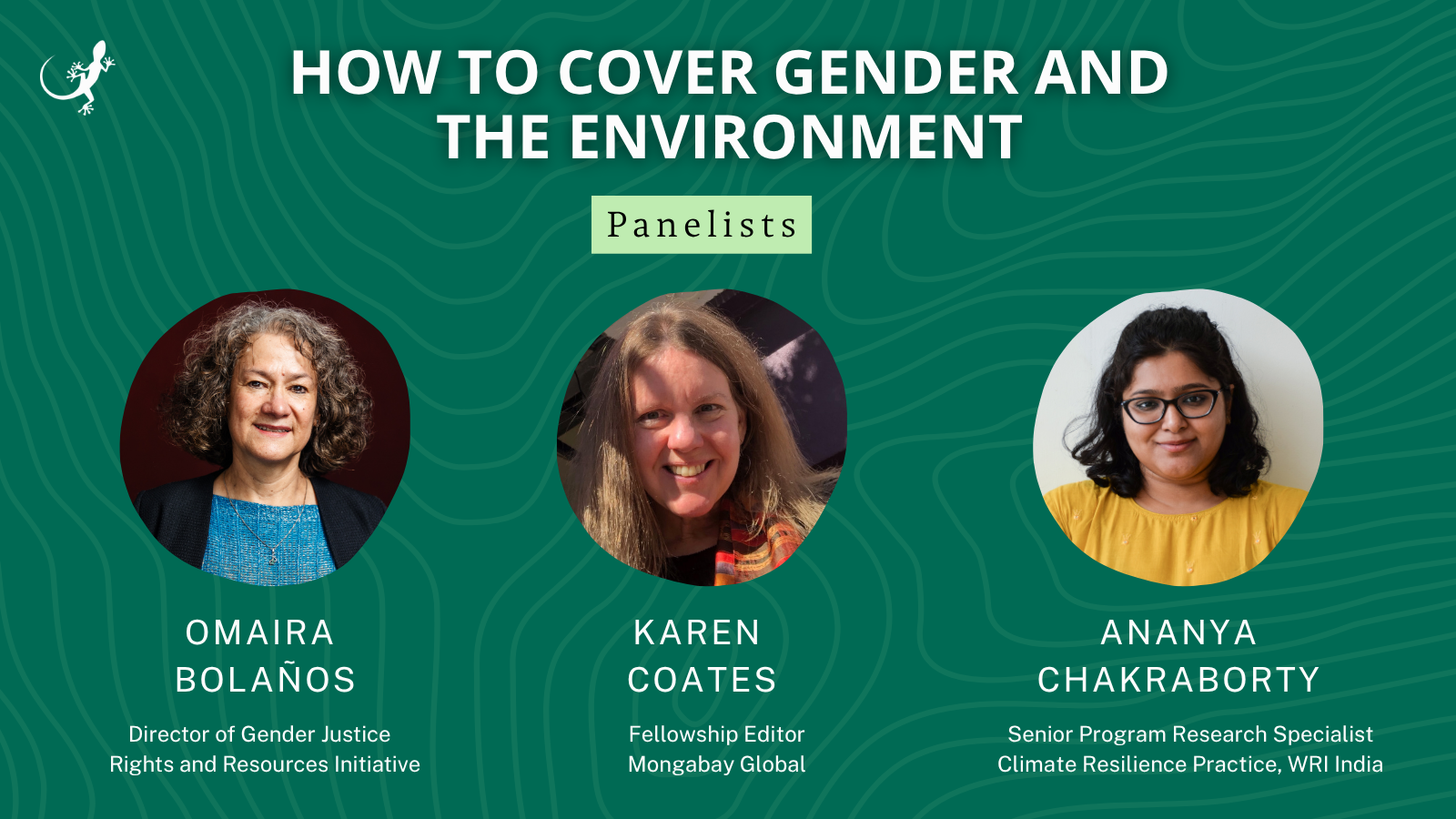
Joining the panel are:
- Karen Coates – Fellowship Editor, Mongabay
- Omaira Bolaños – Director of Gender Justice, Rights and Resources Initiative
- Ananya Chakraborty – Senior Program Research Specialist, Climate Resilience Practice, WRI India
Event details
When: Aug 11, 2026 at 13:00 UTC
Where: A recording of this webinar is available on Mongabay’s YouTube Channel.
Register: Closed
The experts
Karen Coates
Karen Coates is the Fellowship Editor for Mongabay’s Y. Eva Tan Conservation Reporting Fellowship. She also edits the Women in Conservation reporting project. She is a New Mexico-based journalist, editor, and producer with more than 20 years of experience reporting on gender, environment, food, health, and human rights. She lived and worked for many years in Southeast Asia and has led media trainings around the world. She was a Ted Scripps Fellow in Environmental Journalism at the University of Colorado, as well as a fellow with the International Women’s Media Foundation, the International Center for Journalists, and others. She is a co-producer of the documentary film Eternal Harvest and an author of four books. She loves running, hiking, cycling, gardening, camping and everything about the outdoors.
Omaira Bolaños
Omaira Bolaños is the director of Gender Justice for the Rights and Resources Initiative. Omaira has more than 28 years of experience working with Indigenous Peoples, Afro-descendant Peoples, local communities, and women’s organizations. Her expertise includes communities’ collective tenure rights, gender justice, women’s tenure rights, sustainable development, watershed management, community forestry, community-based conservation, applied research, and capacity development. Her research has focused on Indigenous Peoples’ land rights struggles, women’s roles in community forestry, and women’s efforts to rebuild communities from natural disasters. More recently, she is leading analyses on the structural barriers that Indigenous, Afro-descendant and local community women face in accessing global climate and conservation funding. She holds a Ph.D. in Anthropology from the University of Florida.
Ananya Chakraborty
Ananya Chakraborty is a Senior Program Research Specialist with the Climate Resilience Practice program at WRI India. Her work focuses on the social and developmental dimensions of climate adaptation and resilience, with an emphasis on equity and social and gender inclusion in South Asia. Her research interests include migration, agriculture, rural livelihoods, and resilient micro, small, and medium enterprises. Ananya holds a Ph.D. and has built a career at the intersection of climate, society, and development.
Pitch Mongabay a story
If you have a story idea, please submit your pitch via Mongabay’s Opportunities page.
About Mongabay
Mongabay is a nonprofit environmental science and conservation news platform focused on providing cutting-edge independent journalism from nature’s frontline. We pride ourselves on producing reporting that has substantial, tangible impacts around the world.