
How independent reporting enabled a community in Gabon to protect its traditional forest

In March 2021, Mongabay reported on the plight of the Massaha community in northeastern Gabon, where community members were fighting to protect a section of intact rainforest under threat from logging.

The forest, which lies within a concession held by a Chinese logging company, had never been logged, and is home to threatened species such as forest elephants, chimpanzees, gorillas, leopards, pangolins, as well as an abundance of centuries-old trees including protected species such as moabi (Baillonella toxisperma) and kevazingo (Guibourtia tesmannii).

For generations, Massaha residents have depended on the forest for hunting, fishing, and farming. It also holds deep cultural significance, with sacred sites and ancestral villages located within its bounds. Residents of Massaha, have been managing hunting and other use of this forest since 2019. In 2020, the community became the first in Gabon to formally request that part of a logging concession be reclassified as a protected area under the country’s forest code.

Mongabay documented how the community submitted official letters and met repeatedly with government authorities, even as the company accelerated road construction and timber inventory work inside the proposed protected area, progressing before the reclassification request had been considered.

Impact

Mongabay’s persistent coverage rallied public awareness of the situation and prompted international actors to contact Gabon’s environment minister in support of reclassification. As a result, the minister visited the site in March 2022, revoked the company’s permit, and suspended logging operations, setting in motion the permanent protection of the forest. This landmark decision set a precedent for the country’s management of forests, representing the first time an area will be declared protected at the request of the resident community.
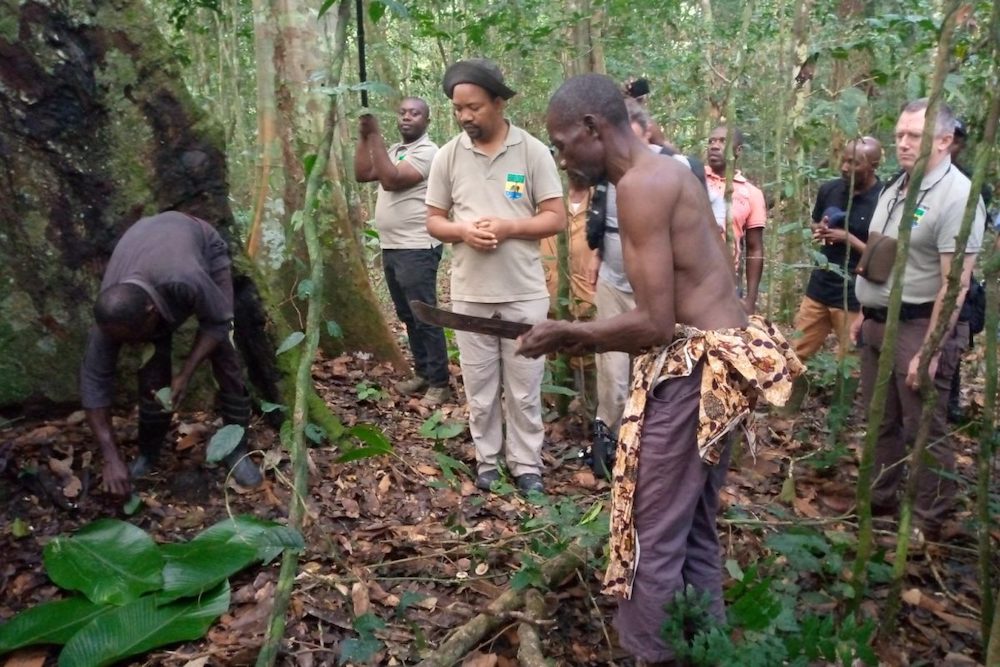
“We came to Massaha to understand the demands of the population, worried about logging that will destroy the sacred sites, so we came to reassure them” — Lee White (right), Gabon’s Minister of the Environment. Image courtesy of Ivindo FM.

In a November 2025 update shared with Mongabay, the journalist who reported the story, Benjamin Evine-Binet confirmed the suspension was upheld by the military regime that took power in Gabon in August 2023 and development of a new forest code recognizing communities’ rights to control their forests continues. “Meanwhile, the community enjoys free access to the forest for its traditional activities. They are confident of a positive resolution of their case — but when?” he said. While some questions remain, this outcome illustrates how independent journalism can empower communities and inform actions.

Support independent environmental journalism

If you are interested in helping shed light on conservation issues such as this, there are two excellent ways you can do so with Mongabay. First, consider making a donation, which directly helps us continue to produce high-impact journalism from nature’s frontline. Second, subscribe to Mongabay’s newsletter to get the latest environmental news delivered right to your inbox, and share whatever articles move you with friends and family.

About Mongabay

Mongabay is a nonprofit environmental science and conservation news platform focused on providing original, reliable, and independent journalism from nature’s frontline. We pride ourselves on producing reporting that has substantial and tangible impacts around the world.

Banner image: Massaha community members in a hunting management meeting. Image courtesy of Graden Froese.