In late 2024, Mongabay Latam published the groundbreaking bilingual data-driven investigation, Amazon Airstrips. Originally published in Spanish, this collaboration between Mongabay and Earth Genome with support from the Pulitzer Center detected 67 clandestine airstrips used for drug transport in the Peruvian regions of Ucayali, Huánuco and Pasco.
The analysis used artificial intelligence (AI) to visually search through satellite information and cross-reference the results with official sources and field reports. Most of these illegal airstrips are located in and around Indigenous communities, reserves for people living in voluntary isolation and forest concessions. Thirty-one runways were found to be concentrated in the province of Atalaya, which has become one of the most violent in the Peruvian Amazon.
The special report was the result of a year-long investigation that combined satellite analysis, AI modeling, drone footage, and over 60 interviews with local and official sources. Conducted under challenging conditions, this reporting was rooted in long-term relationship-building with Indigenous communities. As Mongabay Latam Program Director María Isabel Torres later noted during a presentation at San Francisco climate week, the goal was not only to expose harm, but also to amplify the voices of Indigenous peoples as defenders and leaders actively protecting the rainforest.
These findings revealed the growing overlap between drug trafficking infrastructure and Indigenous territories, prompting statements from politicians and coverage by national media outlets, as well as actions taken by Indigenous organizations and interest from government institutions in learning about the methodology used.
Impact
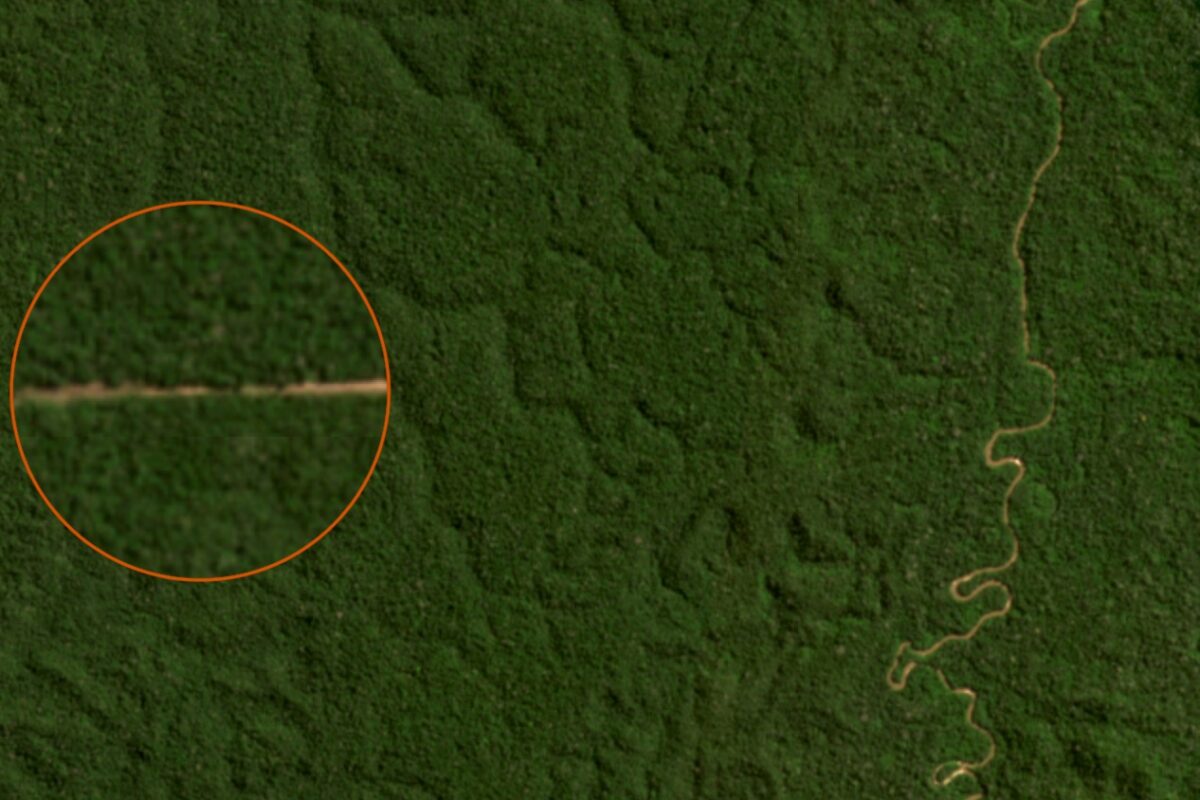
An analysis by Mongabay Latam and Earth Genome found 67 illegal narcotrafficking airstrips hidden in the Peruvian Amazon, like this one inside the Forestal Mendoza forest concession. Image courtesy of Global Forest Watch/Planet.
We are nonprofit.
Help us tell stories of biodiversity loss, climate change & socio-environmental injustice.
As noted in a previous impact post, the Amazon Airstrips series inspired a range of responses across media, civil society, and government sectors. From The Wall Street Journal which published a feature in January 2025 titled “Start With Satellite Images of the Earth. Then Add AI,” which highlighted Mongabay’s use of satellite imagery and AI in journalism, to action by Peruvian authorities and massive coverage of the findings by other media outlets across Peru plus awards like the Future of Media Award in the Best Digital Storytelling category.
Although immediate action by government officials to protect local and Indigenous communities from the proliferation of narcotrafficking activity in the Peruvian Amazon is undoubtably the most important result of the project, the series also won the top global prize for investigative journalism at the Global Investigative Journalism Conference, held this year in Kuala Lumpur, Malaysia, in December 2025.
“We are very happy to have won this award,” said Mongabay Latam managing editor Alexa Velez of the Global Shining Light Award. “It helps us to spread the stories and voices of those currently under threat in the Amazon, who urgently need the government’s help.”
“We are extremely proud of this award, which comes just as we are about to celebrate 10 years of rigorous, specialized journalism on the most urgent environmental issues in Latin America,” said Mongabay Latam’s program director María Isabel Torres. “It recognizes the principles that have been key to Mongabay Latam’s editorial strategy: collaborative and interdisciplinary work, and the use of innovative tools such as satellite image analysis and AI to understand the scale of environmental impact in the region.”
“We are also excited that receiving this award enables us to draw attention again to an issue that remains unresolved: the increase in drug trafficking in the Peruvian Amazon and its devastating impact on the lives of Indigenous people, who are not only living under threat, but are also being killed for defending their territories,” Torres said. “It is important that these stories have received the attention of a global audience thanks to this award. This is crucial because it is the driving force behind our journalism.”
Chosen from among 13 investigative projects in the large outlet category, Mongabay Latam’s reporting had to rise above top competition from media outlets ranging from the BBC to Lighthouse Reports and Politico Europe to claim the top prize.
Rhett Butler, founder and CEO of Mongabay, highlighted this recognition and also the risks taken by the team: “The award honors reporting done under genuine threat. And in this case, the danger was not abstract. The project took shape in regions where reporters think twice before stopping, where one wrong turn can put them face to face with the emissaries of a drug economy that has infiltrated Indigenous territories,” he said.
By bridging advanced AI tools with local voices, Mongabay’s reporting not only revealed the geographic spread of illegal airstrips but also sparked reaction from Indigenous leaders, government officials, international media, and civil society. The ripple effects of this coverage continued into 2025, demonstrating that rigorous, independent journalism can prompt action on some of the most urgent issues facing the Amazon.
Support independent environmental journalism
If you are interested in helping shed light on conservation issues such as this, there are two excellent ways you can do so with Mongabay. First, consider making a donation, which directly helps us continue to produce high-impact journalism from nature’s frontline. Second, subscribe to Mongabay’s newsletter to get the latest environmental news delivered right to your inbox, and share whatever articles move you with friends and family.
About Mongabay
Mongabay is a nonprofit environmental science and conservation news platform focused on providing original, reliable, and independent journalism from nature’s frontline. We pride ourselves on producing reporting that has substantial and tangible impacts around the world.
Banner image: Winners of the 2025 Global Shining Light Award at a ceremony in Kuala Lumpur, Malaysia. María Isabel Torres and Alexa Vélez (third and fourth from left) accepted the award on behalf of the Mongabay Latam and Earth Genome team. Image courtesy of GIJN.
Stay updated
Delivering news and inspiration from nature’s frontline.